گورنمنٹ ڈیپارٹمنٹ اپنے ملازمین سے انکم ٹیکس ریٹرنز کے بارے میں معلومات لے رہے ہیں۔ وہاں آ پ نے ریٹرن کی کاپی نہیں دینی بلکہ صرف بتانا ہے NTN Number اور Filling Status Active or In-active
اگر پھر بھی کاپی مانگی جائے تو NTN Inquiry اور Active Tax Payer کے Online Verification والے پرنٹ دے دیں۔
ایجوکیشن ڈیپارٹمنٹ کا لیٹر پوسٹ کیا ہے آپ دیکھ سکتے ہیں صرف معلومات مانگی گئی ہے نہ کہ ریٹرن کی کاپی۔
FBR has introduced application called "Tax Asaan". App is available in Apple store and google play store, it is very easy to use and made the steps easier in relation to taxation. conveniently available as make tax easy.
User can download this App "Tax Asaan" from Apple Store and Google Play Store.
The Federal Board of Revenue on Friday issued draft income tax return forms for tax year 2019 to seek feedback from all stakeholders (within seven days from 23.08.2019). The FBR also issued SRO 951(I) 2019 here on Friday to propose amendments in the draft electronic return for individuals, salaried individuals and association of persons for tax year 2019. The FBR has sought feedback from all stakeholders on these draft returns within a period of seven days. "No changes will be made in the returns after the due date," the FBR said.
After the proposed amendments the final returns will be uploaded for electronic filing of tax returns for the year 2019 from September 2. The FBR is also considering introducing a digital application (app) for filing of salary income tax returns for the tax year 2019, FBR official added.
The FBR has also launched Tax Asaan, a mobile application providing basic verification features like verification of Active Taxpayer List, sales tax registration and online NTN verification and exemption certificate verification, etc.
I bring the fowlling problems which are being faced by tax consultants,
1) Registration process is not working smoothly and lot of time wasted in getting NTN as well as User ID etc.
2) PSID of tax payments on account of ADO and other tax heads are also not being prepared.
3) A number of complaints are being received that IRIS is not working smoothly and lot of time is being wasted.
4) Now, old as well as new taxpayers are approaching to tax consultants for filing tax declarations under ADO, 2019.
In view of the above facts, it is, requested to your honor to extend the date of filing of declarations under ADO, 2019 for atleast one month upto 31.07.2019 for the sake of convenience to tax consultants and taxpayers.
A sympathy consideration will be highly appreciated.
چالیس ہزار روپے کے پرانے پرائز بانڈ کی فروخت آج سے بند کر دی گئی، اکتیس مارچ دو ہزار بیس کے بعد چالیس ہزار کا پرانا بانڈ صرف کاغذ کا ٹکڑا رہ جائے گا، اسٹیٹ بینک نے غیر رجسٹرڈ بانڈ کی تبدیلی کے لئے طریقہ کار کا اعلان کردیا۔
حکومت کا دستاویزی معیشت کی جانب ایک اور قدم، چالیس ہزار کے پرائز بانڈ کی فروخت بند ہوگئی۔ اب قرعہ اندازی بھی نہیں ہوگی، بانڈ اکتیس مارچ دو ہزار بیس کے بعد ناقابل قبول ہوں گے۔
اسٹیٹ بینک کا کہنا ہے چالیس ہزار والا بانڈ پریمئیم پرائز بانڈ میں تبدیل ہوسکےگا۔ چالیس ہزارکےبانڈ سے سیونگ سرٹیفکیٹ خریدے جاسکتے ہیں
جبکہ چالیس ہزار بانڈ کی ادائیگی اسٹیٹ بینک، نیشنل بینک اور دیگر مخصوص بینکوں کے ذریعے بینک اکاؤنٹ سے ہوگی۔
ایک اندازے کے مطابق چالیس ہزار روپے مالیت کے بانڈز میں سرمایہ کاری کا حجم دو سے تین سو ارب روپے ہے۔
A new website of NADRA/FBR is launched containing details of Assets and foreign Travelling info of all the citizens. Every citizen will be able to see his/her Financial profile.
1)Unregistered industrial / commercial entities (not having STRN) having electricity / gas bill amount in excess of Rs 20,000 per month, extra sales tax would be increased from 5% to 20%
2)Residential consumers be made liable to provide NTN in case electricity bill amount exceeds Rs 1.2 million per year or levy advance income tax withholding of 20%.
3)All exemptions (like exemption on agricultural income) under the Income Tax Law should only be made available to filers so that exempt income is also reported and wealth is reconciled with income reported in the return.
4)Withholding tax on International business class tickets under section 236L is same Rs 16,000 for filer and non-filer, it would be increased to Rs 50,000 for non-filers.
5)Withholding income tax on interest income u/s 151 is 10% for filer and 17.5% for non-filer. Rate would be increased to 30% for non-filers.
6)Annual private motor vehicle tax u/s 234 for non-filers is Rs 30,000 for 2000 CC and above. Rate for non-filers would be increased to Rs 200,000 for 2000 CC and above.
7)Rate of income tax on Filer as well as Non-Filer Commercial / industrial connections of electricity is 12% and 5% respectively. Rate of tax for Non Filer Commercial / industrial connections would be increased to 25%
8)At present, 12% WHT is being collected from owners of marriage halls on their electricity bills, which does not represent actual tax on their income. Moreover, the same is somehow minimized through use of generators. In order to avoid this, Capacity Tax would be imposed on marriage halls on the basis of per square feet coverage area.
List of registered Marriage halls paying capacity tax on per square foot basis would be on internet and accessible to all so that it can easily be identified who is not on the list thereby forcing them to get themselves register and pay tax.
9)Tax on capital gain on disposal of shares of Listed Company is 15% for Filers and 20% for Non-Filers. Rate of tax for Non-Filers would be increased to 30%
10)List of top 100 restaurants registered in Federal / Provincial sales tax with the amount of tax paid, would be on internet accessible to all so that famous busy restaurants who are not on this list or on bottom of the list are induced not to embarrass themselves by declaring low sales.
Lottery system be introduced for invoice collected by customers of restaurants and uploaded on designated website. Moreover, invoices submitted by customers should be cross checked with invoices reported by restaurants in their monthly sales tax return.
11)Advance tax 1% and 2% is collected from filer and non-filers respectively on sale of immovable property. For sale of land above 250 square yards, rate of advance tax would be increased to 10%
12)In addition to above referred tax, the real estate constructors should pay additional withholding tax when they get the constructed property registered in the name of buyers of their constructed property. This would be inline with withholding taxes imposed on industries on transactions executed by them.
12)Purchase of land (above specified limit) is only allowed by filers, however, holding of land and its sale by non-filers is still allowed. Holding of land by non-filers should be made more expensive by asking authorities collecting property tax (cantonment boards / societies / registrar) to collect adjustable advance income tax, from non-Filers, on behalf of the Federal Government as follows:
a) Rs 500,000 per year for 800 yards or more but less than 1800 yards.
b) Rs 1 million per year for 1800 yards and above.
c) So that such property comes for sale.
13)Currently, advance income tax on international travel is being collected as follows, which would be increased as follows:
a) First / Executive class – Rs 16,000 be increased to Rs 35,000 for Non-Filers
b) Other excluding Economy class - Rs 12,000 be increased to Rs 20,000 for Non-Filers
c) Economy class – No tax is being collected on economy class tickets. To allow data mining, marginal withholding tax (say Rs 200 - 500) would be imposed on Non-Filers just to gather data of frequent travelers.
14) mobile phone connection should only be available to Filers per CNIC
Plato, a Greek philosopher, said, “When there is an income tax, the just man will pay more and the unjust less on the same amount of income.” Plato was right – you can see the clever ways in which people evade taxes these days. For instance, when buying a property, the seller and the buyer both agree to show less value for the purchased property on the sales deed, just so they can pay less taxes. Withholding tax is to be paid by the buyer and Capital Gains Tax is to be paid by the seller. Now you may ask what these taxes are and how many kinds of property taxes there are in Pakistan. We will discuss all of these in great detail.
DIFFERENT TYPES OF PROPERTY TAXES IN PAKISTAN
Following are the different types of property taxes in Pakistan:
Capital Gains Tax (CGT)
Capital Value Tax (CVT)
Stamp Duty
Withholding Tax or Advance Tax
Paying property taxes is like going to the dentist. It is important although you aren’t really happy about it. However, if you are trying to find a way of not paying property taxes, you might get into deep trouble with Federal Board of Revenue. FBR receives information – every bit of detail about your income, the investments you have made and real estate transactions. In short, all kinds of details pertaining to money matters. FBR will take some time in matching up your income with the filed tax returns and if there is a disparity, they will send you a notice or they will charge you a penalty fee or they might freeze your assets.
With new policies and developments taking place, there is good news for overseas Pakistanis wanting to tap into Pakistan’s real estate market. The government has loosened the noose around those expats, who are non-filers of income tax returns. Overseas Pakistanis can now invest in the real estate sector of Pakistan with ease. Before we discuss various kinds of taxes levied on property purchase and also on sale of property, let us look at the topic in view of the current news snippets related to taxes in Pakistan.
WIDENING GAP
Federal Board of Revenue (FBR) realized that there is a huge gap between “deputy commissioner (DC) rates” and market prices of the said property. Due to this gap, undocumented money circulated in the market. This resulted in tax evasion. Since DC rates were low as compared to the actual market rates, real estate transactions took place based on DC rates, while in reality the actual sum of money traded between sellers and buyers was recorded as per the market value. For instance, if a 240 sq yd plot with a DC rate of Rs 30,000, but a market value of Rs. 70,000 is sold, on paper it shows DC value, while seller gets Rs. 70,000. This difference of Rs. 40,000 is black money. Because of this, neither the government nor income tax authorities could identify the total amount of income sellers were making in real estate sector business.
BRINGING PROVINCES INTO THE TAX NET – A TAXING PROCESS
To bring those earning black money into the tax net, the government of Pakistan and FBR have revised valuation tables for properties. Abolishing DC rates, these new property valuation rates will determine the actual property value. According toFBR Valuation Tables 2019, property valuation for the real estate sector have seen an increase across 20 major cities of Pakistan. This might result in a slight dip in the real estate sector’s business, but these tax policies by FBR should continue. Although for a few days to come there will be a decline in trading activity, property prices may also see a dip. At low property prices, people belonging to the middle class sector can fulfill their dream of becoming a homeowner. For the common man, there is a light at the end of the tunnel.
INCREASE IN PROPERTY TAX COLLECTION
After the establishment of Directorate DGIP, there has been an increase in property tax collection
According to a news report published in The News on April 23, 2019, “Tax experts said the establishment of the directorate created a fear and people preferred to declare property values near to the fair market values. They said the valuations notified by the provinces are very low but due to transactions at the higher rates the property tax collection increased significantly.”
The same report further revealed Punjab is leading the race by collecting PKR 5.02 billion during the first half of the current fiscal year. Around the same time, Sindh raked in PKR 1.83 billion from July to December. Both the provinces recorded a sharp increase in the amount from the last fiscal year: while Punjab showed a 22.64 percent increase, Sindh witnessed 73.83 percent growth in tax collection. Khyber Pakhtunkhwa (KPK) and Balochistan received PKR 450 million and PKR 83 million, respectively.
WHAT IS A PROPERTY TAX?
Property tax in Pakistan is a provincial tax levied on annual rental value of the property, based on Urban Immovable Property Tax Acts of respective provinces. Tax rates are different for every province. It is either a flat rate, or a percentage of the annual rental value. Rental value does not mean that the property has to be rented out. It simply gives an assessed value by the government of how much rent would be generated, had the building been let out. For each province, rate of taxation differs depending on whether the property is rented out or self-occupied.
According to Excise, Taxation & Narcotics Control Department, Punjab, there is a 5% annual rental value that is levied as tax. Annual rental value is determined by assessing properties based on their type – residential or commercial, locality and whether it is rented or self-occupied. As per the Excise, Taxation & Narcotics Department Sindh, it doesn’t matter whether the property is rented out or not. The tax is levied at a rate of 25% of the annual rental value of the property. For a comprehensive breakdown of property taxes, you can check out our blog on understanding property tax rates in Pakistan.
KINDS OF TAX ON SALE OF PROPERTY IN PAKISTAN
When it comes to taxes on sale of property in Pakistan, there is Capital Gains Tax which needs to be paid on the gain of profits. Let’s discuss it in detail.
Capital Gains Tax (CGT)
It is best to file CGT in time to avoid being a defaulter
Let us now understand what is Capital Gains Tax on property in Pakistan 2018-2019? Capital Gains Tax (CGT)is a federal tax to be paid by the seller. When the seller makes profits on selling property (capital asset), it is the profit (capital gain) which is taxed, hence the name. According to the Finance Act 2017, CGT is levied only when the property is sold within three years of its purchase. The rate of taxation is 10% for the first year, 7.5% if sold during second year and 5% if sold during the third year. These gains are to be calculated according to the fair market value, based on FBR’s valuation table. Any property held for more than three years will not make the seller liable for payment of CGT.
TYPES OF TAXES ON PROPERTY PURCHASE IN PAKISTAN
When a person decides to buy property in Pakistan, they want to know everything: do they have enough resources? Do they need to apply for a home loan? Should they buy properties in Karachi? Or should theyinvest in plots in Lahore? How much tax is levied on property purchase? They want to weigh all their options before making this big decision. Let us discuss property purchase tax in Pakistan in greater detail.
Capital Value Tax (CVT) & Stamp Duty
Those interested in buying property, keep in mind that they have to pay quite a few taxes before becoming owners of the property. Capital Value Tax (CVT)is a provincial tax and is paid by the buyer at the time of buying property. As the name suggests, it is payable on the capital value of an acquired asset. The Capital Value Tax or CVT is levied at the rate of 2% of the recorded value according to Finance Act, 2006.
Property that is transferred as a gift, an exchange or relinquishing the rights on a property all come under Capital Value Tax. However, transfer of property between parents, spouse or any of your blood relatives either as a gift or through inheritance have been excluded. In cases where it is a gift or exchange, or where property value is not mentioned in the transaction, the value of the property is calculated according to the values determined through the valuation tables.
According to Budget 2018-19,federal government had recommended the abolition of DC rates. Recommendations had also been made to reduce the CVT and Stamp Duty to a total of 1%. Neither of these recommendations have been implemented by the provinces so far. So, currently the total of CVT and Stamp Duty for urban property still stands at a total of 5% (2% CVT and 3% Stamp Duty).
Stamp Duty is basically a tax paid on the legal document at the time of purchasing property. Under the Stamp Act 1899, Stamp Duty is levied at 3% of the DC rates of the property.
Withholding Tax (WHT) to be paid by both buyers and sellers
In addition to CVT and Stamp Duty, Withholding Tax (WHT) is of utmost importance. It is a federal tax payable by both buyers and sellers on a property deal. Few points need to be taken into consideration:
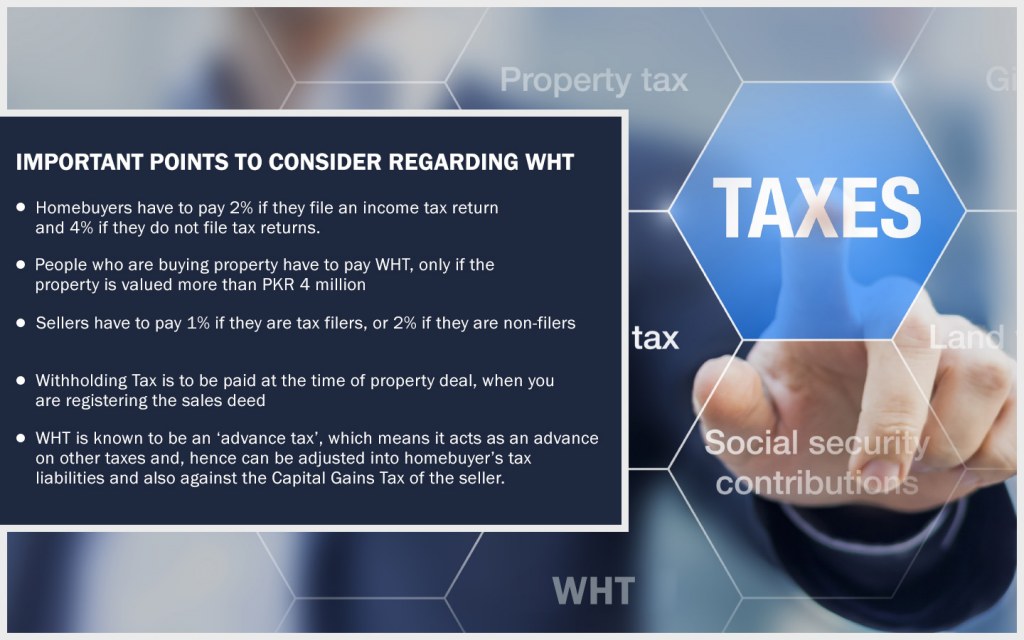
Important points to consider regarding Withholding Tax WHT
Homebuyers have to pay 2% if they file an income tax return and 4% if they do not file tax returns.
People who are buying property have to pay WHT, only if the property is valued more than PKR 4 million
Sellers have to pay 1% if they are tax filers, or 2% if they are non-filers
Withholding Tax is to be paid at the time of property deal, when you are registering the sales deed
WHT is known to be an ‘advance tax’, which means it acts as an advance on other taxes and, hence can be adjusted into homebuyer’s tax liabilities and also against the Capital Gains Tax of the seller.
Under the Budget 2018-19, FBR rates were to be abolished, sellers would no longer have to pay Advance Tax and rates would change for buyers as well. However, to ensure that the declared values of properties are fair, the government has formed the Directorate of Immovable Property (DGIP). The plan to establish it was declared in Finance Act 2018. It will be authorized to conduct geo-mapping of plots, apartments and all kinds of housing schemes and projects. It will also determine the valuation of properties. It will also track those areas of real estate where tax evasion is a possibility – especially while collecting Withholding Taxes.
These are some of the most common property taxes in Pakistan. You can also calculate property taxes for 2018-2019 for Sindh and Punjab from the official websites of Excise Taxation and Narcotics Control Department, Government of Sindh and Government of Punjab, respectively. These are a few updates on taxes on property purchase and also related to taxes on sale of property in Pakistan.
نئے چیرمین ایف بی آر شبر زیدی نے جمعہ کی صبح ادارے کا چارج سمبھال لیا اور اس کے بعد افسران سے خطاب کیا چیرمین ایف بی آر نے ٹیکس نظام میں بہتری لانے کے اپنے ویثرن کا تذکرہ کیا اور ادارے کو درپیش مسائل کا ذکر کیا۔ نئے چیرمین نے ٹیکس گزاروں کی سہولت کے لئے مکمل آٹو میٹڈ ٹیکس نظام کی اہمیت پر زور دیا۔ انہوں نے مزید کہا کہ تمام ٹرانزیکشنز کو ڈاکیومینٹڈ کرنے کی ضرورت ہے تا کہ ریونیو میں اضافہ لایا جا سکے۔ نئے چیرمین نے افسران کو یقین دلایا کہ ان کہ مسائل کو حل کیا جائے گا اور مزید کہا کہ تمام افسران کی سپورٹ سے ھی وہ ادارے میں بہتری لاسکتے ہیں۔ انہوں نے وزیراعظم کا شکریہ ادا کیا اور کہا کہ وہ اس بھاری ذمہ داری کو احسن طریقے سے پورا کریں گے۔ نئے چیرمین نے افسران کے سوالات کا جواب نہایت خوشگوار ما حول میں دیا اور امید ظاہر کی کہ ان کی مستقبل میں افسران سے ریگولر ملاقات ہو گی
KARACHI: Federal Board of Revenue (FBR) has been suggested to restrict non-filers of income tax returns from purchasing gold bars, jewelry and other luxury goods in order to broaden tax net.
“In addition to the restriction on purchase of immovable property and motor vehicles by non-filers, the punishment should be made even severe by foisting a restriction or imposing an additional charge of tax, on non-filers upon purchase of other luxury goods, including gold bars and jewelry, paintings, antiques, electronics etc.”
The suggestions were made by Institute of Chartered Accountants of Pakistan (ICAP) in its tax proposals for budget 2019/2020 in order to broaden the tax base and documentation of economy.
The institute said that the proposed restriction would eradicate the indifference between a filer and non-filer, and giving a sense of benefit to the filers, while non- filers should be penalized heavily.
Giving recommendations and rationales in this regard it said:
— Increase withholding income tax and sales tax for non-filers/unregistered persons by 50 percent higher rates; ‘further tax’ on sale to unregistered person should be increased to 5 percent.
— Extra tax on commercial and industrial utilities connection should be increased to 15 percent for unregistered person.
— Separate teams should be made and assigned responsibilities to visit the local shops, retail outlets and services providers to verify that proper sales tax invoices are generated and persons are registered with revenue authorities, if not they should be heavily penalized and compulsorily registered.
— All utility connections amounting to Rs2.4 million or more of non-filers should be forced to get registered by issuance of Show-Cause Notices.
In case of noncompliance, their utility connections should be disconnected.
— An additional charge of tax should be foisted on non-filers upon purchase of luxury goods, such as gold bars and jewelry, paintings, antiques, electronics etc.
The newly appointed Chairman Federal Board of Revenue Syed Muhammad Shabbar Zaidi is a regular tax payer and paid Rs 17.89 million (Rs17,897,927) in the tax year 2018.
According to documents seen by APP the new FBR Chief having the CNIC: 42301-1740521-7, paid Rs 15.36 million (Rs15,369,849) for tax year 2017; Rs 11.2 million (Rs11,206,943) for tax year 2016 and Rs 7.3 million Rs 7,369,820) for Tax year 2015.
Contrary to the social media reports and the report by a news channel, the FBR record clearly shows that Shabbar Zaidi has been filing his returns regularly.
1- For a limited time say for 2 years, Return filed u/s. 120 may be treated as final Assessment only on one condition. Taxpayers declares 100% original taxable revenue. In result no FBR official can open Audit cases against taxpayers. The declared version is final.
2- Removal of Indirect Taxes and implement a simple and unique tax collection system for collection of Direct taxes.
3- Introduce Simple Return for whole tax community along with one flat rate of tax.
4- Simplyfy the Withholding Tax Collection. Tax may be collected only from Section 148, 149, 155. Others maybe removed as these creats a burden over businessmen. Basically Government had shifted her burden to taxpayer to act as Tax collection agent on behalf of her, hence, escaped from duties, yet Harass the withholding agent in soma you ways. Should be soften.
5- After implementing these, the question will arise what FBR officials will do then? In opinion they will do the real work and that is BTB. Visits may be done door to door throughout Pakistan. Run awareness programs among people. Give them confidence to declare whatever they want, Government will not Harass them.
Apart from all of the above, in my opinion, people are eager to give tax for the betterment of their home land. But when they see corruption, they see their money is robbed in daylight, plus government officials ask bribes to resolve their planted issues u/s. 165/161/205/182 penalties etc they do not turn in as taxpayer at first, and if they become taxpayers, they declare their taxable profits suppressed resulting low tax payments or no payment at all. Because they know if Audit proceedings started, they have to give consideration under the table which immensely fracturing the trust of taxpayers over tax system.
Lastly but not least, these may help in reduce corruption and harassment which are key elements of this faulty system.
There are many other points as well but the above mentioned are the key ones in my opinion which will definitely enhance the trust of people over Government.
Welcome! I’m Tasleem Faraz Minhas - the author of this blog and a seasoned Finance Executive with 22+ years of cross-border experience across Saudi Arabia, the UAE, and Pakistan. Throughout my career, I’ve consistently delivered strong, measurable outcomes in financial management, digital transformation, and tax compliance. I’ve led successful ERP implementations, driven multi-million SAR/AED cost efficiencies, and strengthened cash-flow performance for large and diverse organizations. Through this blog, I aim to share insights, practical guidance, and real-world finance and tax expertise that professionals can apply with confidence.